AI in fashion: applications and limits
Applications of AI in fashion use computational models to recognize attributes, retrieve knowledge, generate visualizations, and support decisions across creation, development, and commercialization. Their limits depend on the data, use context, evaluation, human oversight, and integration with the product workflow.
On this page
What is AI in fashion?
The applications and limits of AI in fashion appear in the use of models to perform or support tasks that depend on language, image, video, sales series, and product data. The field includes recognizing garments and attributes, relating text and image, retrieving collection information, forecasting demand, recommending items, generating visualizations, and assisting decisions. Fashionpedia demonstrates the importance of structure: its ontology links categories, parts, and hundreds of attributes, allowing computer vision to treat a garment as a set of localized properties rather than merely an image labeled “dress” or “shirt.”
This granularity connects to fashion taxonomy and the tech pack. A model can suggest that an image contains a particular neckline, sleeve, or print, but the suggestion only becomes operational data after validation, association with the correct product, and source recording. Without identity and version, automation may simply accelerate the creation of another conflicting record.
Where can AI be applied?
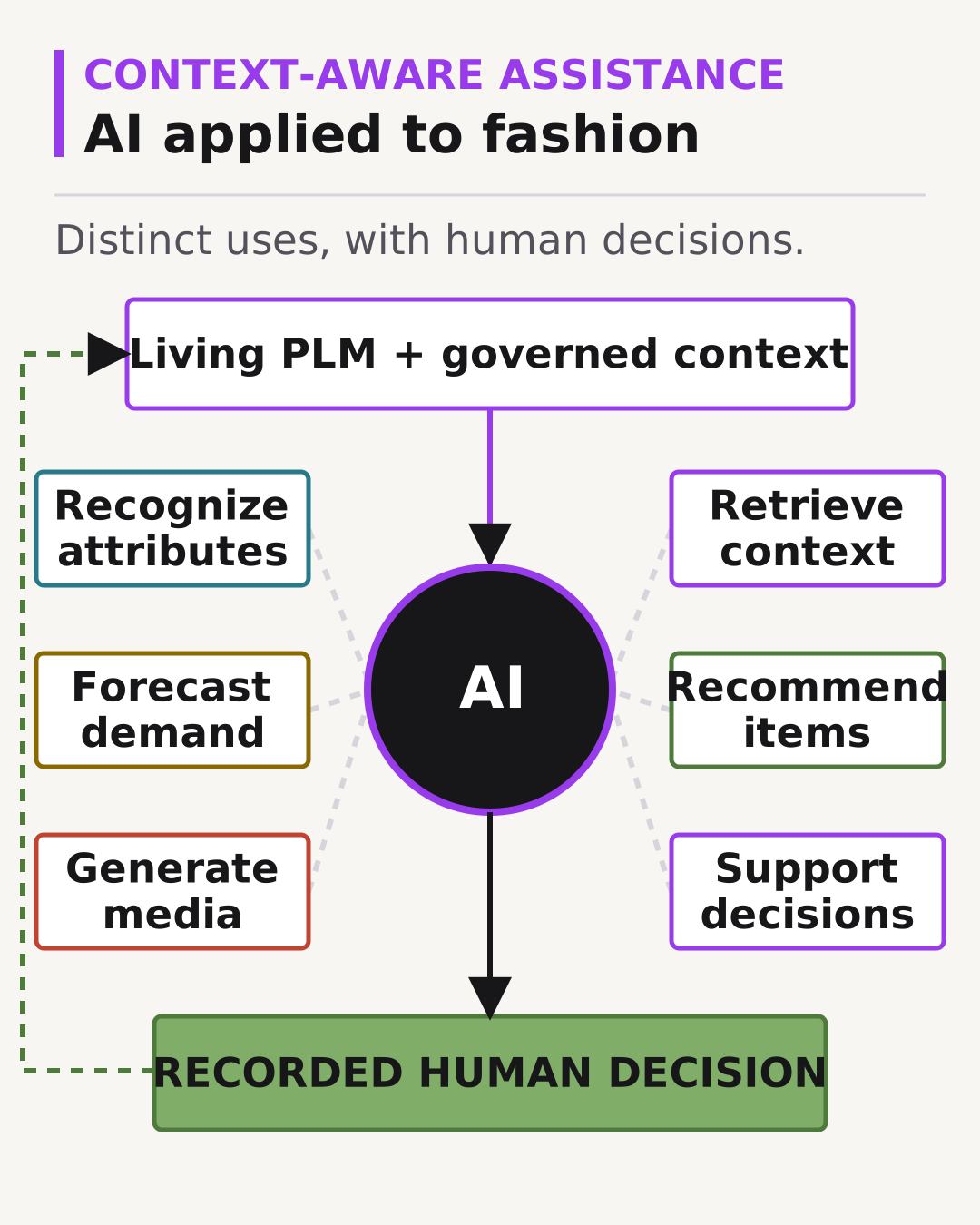
AI can operate across complementary fronts rather than one fixed sequence. In perception, computer vision models segment items and recognize attributes. In retrieval, language and embeddings help locate references, materials, decisions, and similar products. Forecasting combines history, product attributes, and commercial variables to estimate demand. Recommendation models compatibility between items or suitability for a person and occasion. In generation, models produce text, image, or video conditioned on inputs. In assistance, they summarize differences, propose entries, or organize next steps for validation by a responsible person.
Virtual try-on illustrates both capability and limit. TryOnDiffusion researches how to visualize a garment on another person from two images; Fashion-VDM extends the problem to video, where identity, motion, garment detail, and temporal consistency need to coexist. The output is a computational visualization, not physical evidence of fit, comfort, construction, or size. It does not replace a sample, fitting, measurement chart, or quality control.
In product development, usefulness appears when AI finds authorized context in fashion PLM. It can compare tech-pack versions, flag missing fields, retrieve comments attached to a sample, or explain why an item is blocked. The model should not silently choose the “truth” among a spreadsheet, message, and system; collection governance needs to indicate which record is valid and who may approve a change.
How can AI be implemented responsibly?
Responsible AI implementation begins with the question and context, not the model. The task, user, permitted data, supported decision, tolerable error, oversight, and performance evidence need to be defined. NIST organizes this work as govern, map, measure, and manage. In fashion, mapping includes representing bodies and products adequately, protecting intellectual property and personal data, separating inspiration from copying, and testing behavior across relevant categories, materials, and markets.
Evaluation must follow the real workflow. Average accuracy can hide failures on rare attributes; a visually convincing image can alter essential garment details; a correct summary can be attached to an old version. Technical metrics therefore need to be combined with expert review, a decision trail, and monitoring. When media is generated, media provenance and labeling help distinguish documentary records from synthetic content.
Why does context matter more than a demo?
Context matters because the same model can be useful or unsuitable depending on the decision, source, and version. A demo answers “can this be generated?”; an operation must answer “with which data, for which product, under which permission, with what risk, and who validates it?” Organizing those answers is part of collection governance and lifecycle management, not an automatic property of the model.
AI in fashion therefore matures when it stops being a collection of effects and begins participating in a verifiable system of work. The goal is not to remove authorship from teams, but to expand their capacity to perceive, forecast, retrieve, and compare information without erasing accountability.
Verified facts
- The Fashionpedia dataset contains 48,825 clothing images with item segmentation and fine-grained attributes associated with segmented categories.
Source: fashionpedia.github.io ↗ - The Fashionpedia ontology contains 27 main apparel categories, 19 apparel parts, and 294 fine-grained attributes across nine supercategories.
Source: fashionpedia.github.io ↗ - The task proposed by Fashionpedia combines instance segmentation with visual attribute recognition.
Source: arxiv.org ↗ - TryOnDiffusion receives an image of a person and an image of a garment worn by another person to generate a visualization of the garment on the input person.
Source: research.google ↗ - TryOnDiffusion uses a diffusion architecture with two U-Nets and cross-attention to combine garment-detail preservation with changes in body pose and shape.
Source: research.google ↗ - Fashion-VDM receives a garment image and a person video to generate a virtual try-on video, with preserving identity and motion among the method's goals.
Source: research.google ↗ - The temporal strategy described by Fashion-VDM produces 64-frame, 512-pixel videos in a single pass.
Source: research.google ↗ - A fashion retail study modeled demand forecasting for new items using product attributes and merchandising factors as inputs.
Source: arxiv.org ↗ - A style-conditioned outfit recommendation study modeled item compatibility using product images and categories.
Source: arxiv.org ↗ - The core of the NIST AI Risk Management Framework consists of four functions: govern, map, measure, and manage.
Source: airc.nist.gov ↗ - In the NIST AI RMF Map function, use context, laws, norms, expectations, users, impacts, and limitations are to be understood and documented.
Source: airc.nist.gov ↗ - The European AI Act transparency rules apply from August 2026 and include obligations to make AI-generated content identifiable in defined cases.
Source: digital-strategy.ec.europa.eu ↗ - The C2PA specification provides the digital type trainedAlgorithmicMedia to record media created by AI or machine-learning systems in provenance manifests.
Source: c2pa.org ↗
Related entries

Fashion PLM: data, product, and lifecycle
Fashion PLM is the structured management of the data, decisions, and workflows that follow a product and a collection from concept through post-launch. It connects tech packs, materials, costs, samples, approvals, suppliers, and versions so that every function works from a traceable product definition.
Collection governance: roles, gates, and evidence
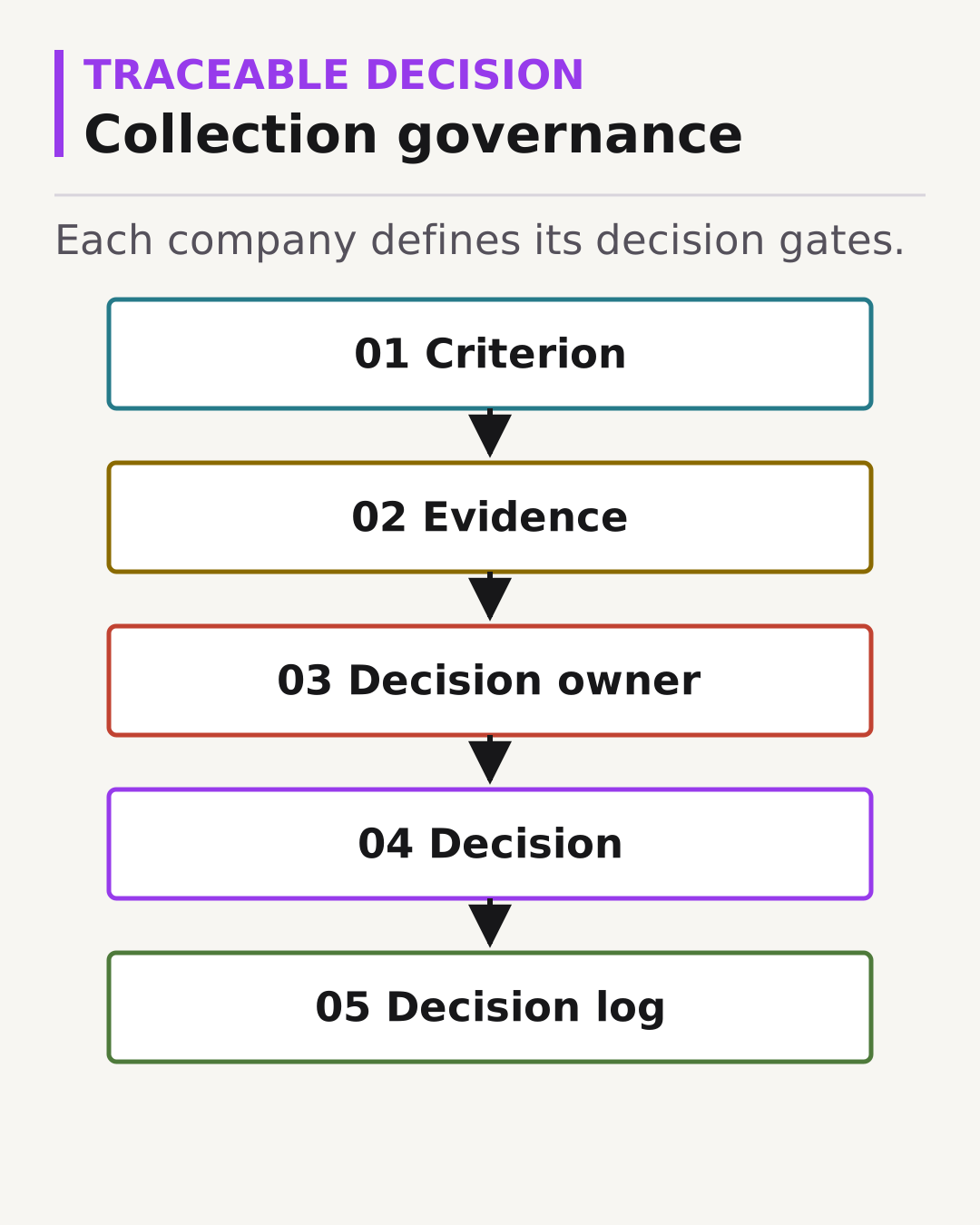
Collection governance describes the practice of making roles, criteria, evidence, decisions, and exceptions explicit in fashion development. The term does not designate one industry standard; it synthesizes principles of process management, evidence-based decisions, due diligence, and traceability.
Governing fashion context
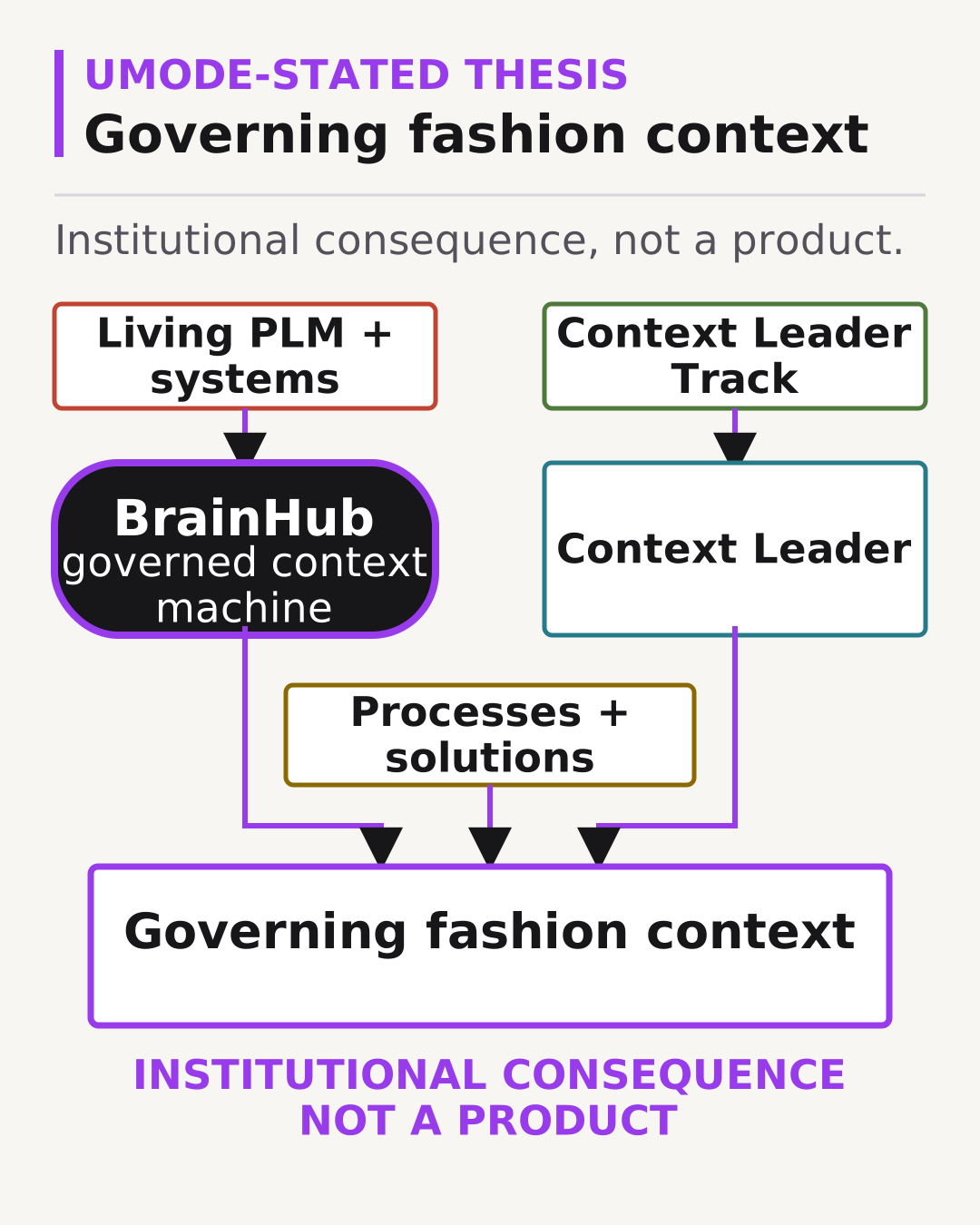
Governing fashion context is uMode's name for a proposed relationship among systems of record, BrainHub, governance, and the Context Leader Track. The expression is not a product, technical standard, or recognized industry category, and no independent validation of its outcomes has been published.

Fashion product technical specification
A technical specification is the controlled information set that translates an approved fashion product into verifiable sampling and manufacturing requirements. It brings together drawings, materials, measurements, construction, tolerances, identification, labelling, comments and revision history; its content varies by category, company, market and stage.
Sources
- https://fashionpedia.github.io/home/
- https://arxiv.org/abs/2004.12276
- https://research.google/pubs/tryondiffusion-a-tale-of-two-u-nets/
- https://research.google/pubs/fashion-vdm-video-diffusion-model-for-virtual-try-on/
- https://arxiv.org/abs/1907.01960
- https://arxiv.org/abs/2203.16161
- https://airc.nist.gov/airmf-resources/airmf/5-sec-core/
- https://digital-strategy.ec.europa.eu/en/policies/regulatory-framework-ai
- https://c2pa.org/specifications/specifications/2.1/specs/_attachments/C2PA_Specification.pdf
Want to apply this to your operation?