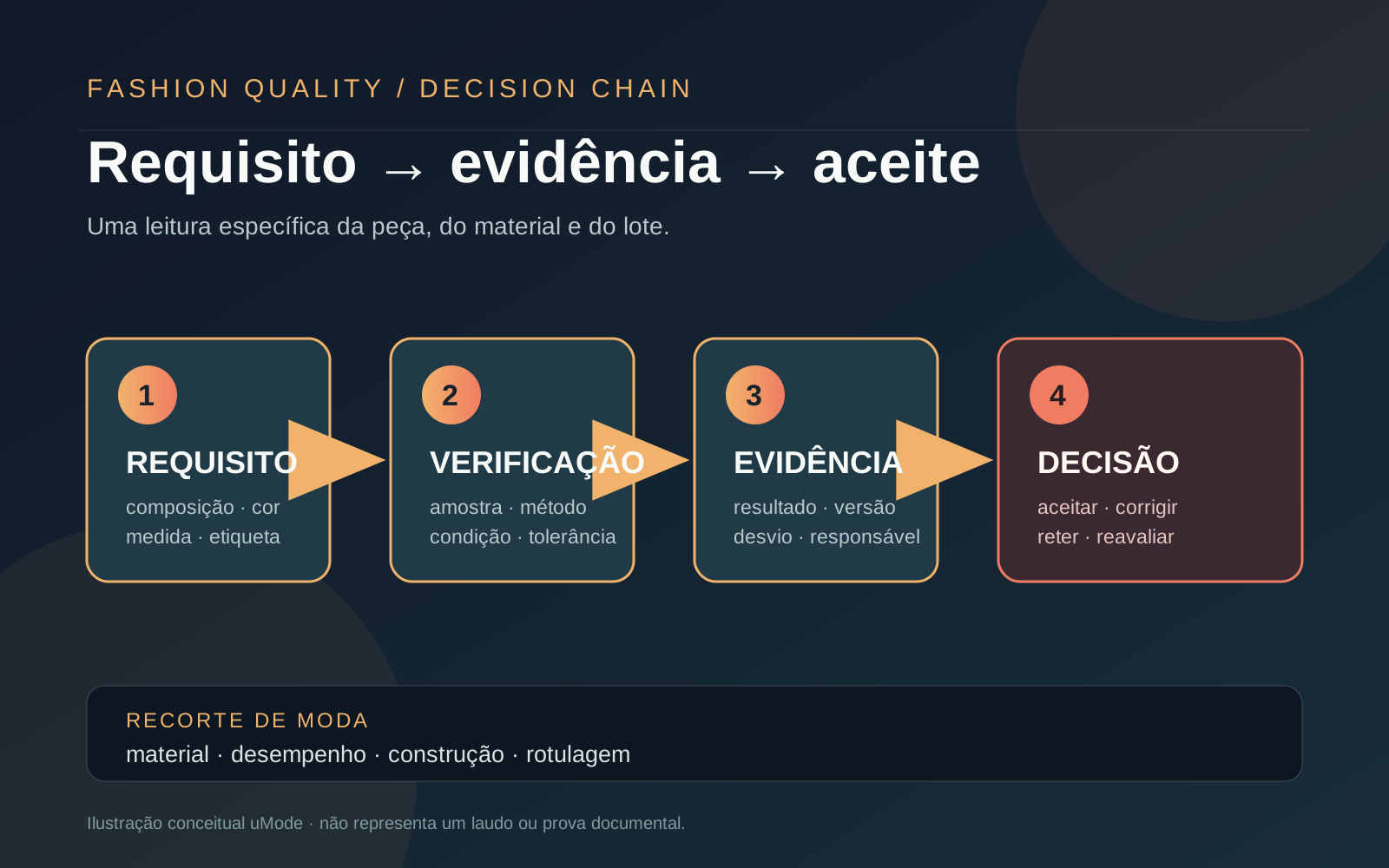
Fashion product technical specification
A technical specification is the controlled information set that translates an approved fashion product into verifiable sampling and manufacturing requirements. It brings together drawings, materials, measurements, construction, tolerances, identification, labelling, comments and revision history; its content varies by category, company, market and stage.

On this page
What is a fashion technical specification?
A technical specification is the controlled reference that converts a product decision into verifiable instructions and criteria. In different companies it may be one sheet, a document package or a digital record; the complete set is often called a tech pack. Its role in fashion product development is to let design, engineering, patternmaking, purchasing, suppliers, quality and manufacturing work from the same version.
It is not merely an attractive drawing or a form completed once. It is living documentation during sampling and approval, with product identification, author, date, revision, status and decision owners. A tech pack brings together recurring components but does not follow one universal template: category, process, company and market determine the depth required.
What does a technical specification usually contain?
The visual core includes front, back and detail technical drawings with callouts that do not depend on aesthetic interpretation. The material core identifies fabrics, trims, colours, approved suppliers or references, placement and, where applicable, consumption. The dimensional core records points of measure, values by size and tolerances; body measurements and garment measurements must be distinguished because they serve different functions.
Construction and finishing complete the description: seam and stitch types, allowances, reinforcements, critical sequence, treatments, print, embroidery, label placement, packaging and appearance criteria. The specification for a pilot garment may also collect fit comments, detail photographs and pattern corrections. For a size range, pattern grading and the graded chart need to remain synchronised with the drawing and approved base size.
Not every field belongs to every product. A flat-knit garment, a washed jean and a handbag require different specifications. The test is whether the record includes the information needed to make and verify the item without hiding critical decisions in parallel messages.
How do measurements, tolerances and quality relate?
A measurement without a method may be ambiguous, and a measurement without tolerance does not define the acceptable limit. Each point of measure should therefore have a consistent name, location and procedure. ISO 8559 provides anthropometric references for the body, but ISO 8559-3 itself clarifies that its table does not contain garment measurements; the company still needs to define product dimensions, ease and grading rules.
Tolerances connect the specification to quality control. They do not permit arbitrary variation: they delimit the interval that preserves fit, function and appearance. Likewise, “reinforced seam” is less verifiable than a stated construction, stitch, position and requirement. Industrial sewing needs criteria compatible with the actual machine, material and operation.
How does the specification change during sampling and production?
The specification evolves with every approved decision. Fit comments may alter patterns and measurements; a material substitution may change consumption, needle, thread, shrinkage and care; a test may require a new construction. Every revision should record what changed, who approved it and from which sample, order or lot it applies. Files sent without a version number, or decisions kept only in email and chat, create competing versions of truth.
Product lifecycle management systems may centralise fields, attachments and approvals, but specification quality still depends on technical content and governance. The medium does not correct an incomplete drawing, an incoherent tolerance or an informal approval.
Why do labelling and compliance belong in the specification?
The specification should translate destination-market requirements before production release. In Brazil, textile labelling regulated by Inmetro requires identification, origin, composition, care and size or dimension where applicable, in permanent, visible information in Portuguese. Other markets have their own rules; in the United States, for example, the FTC requires a reasonable basis for care instructions.
Recording these data in the specification reduces the risk that a label is treated as a graphic detail at the end of the process. A well-governed specification creates traceability between intent, approved sample and manufactured product. It does not eliminate fitting, testing or inspection, but provides the shared reference that makes those controls comparable.
Verified facts
- The Skills England occupational standard describes tech packs containing specifications, working drawings, measurements, labelling, quality standards, tolerances and materials.
Source: skillsengland.education.gov.uk ↗ - The same standard includes tech packs, specifications, tracking, review notes and product history among technical records whose incorrect completion has consequences.
Source: skillsengland.education.gov.uk ↗ - Production quality specifications may define seam types, stitch types, tolerances and product finish.
Source: skillsengland.education.gov.uk ↗ - University of the Arts London lists specification drawings, garment fit logs and graded size charts as production-standard documentation.
Source: arts.ac.uk ↗ - UAL addresses fit evaluation through a physical garment and comparison between physical and 3D digital samples.
Source: arts.ac.uk ↗ - UAL notes that technical requirements and processes may be comparable or different across brands and market areas.
Source: arts.ac.uk ↗ - ISO 8559-1:2017 defines anthropometric measurements that may support size and shape profiles for garment development.
Source: iso.org ↗ - ISO 8559-3:2018 addresses body-measurement tables and states that garment dimensions are not included in that document.
Source: iso.org ↗ - In Brazil, Inmetro Ordinance 118/2021 requires responsible-party identification, country of origin, fibre composition, care instructions and size or dimension where applicable, in a permanent, visible medium and in Portuguese.
Source: gov.br ↗ - Inmetro states that a textile product covered by the regulation and sold in Brazil with incorrect mandatory information is noncompliant.
Source: gov.br ↗ - The FTC Care Labeling Rule requires a reasonable basis for care information disclosed to consumers.
Source: ftc.gov ↗ - FIT's technical curriculum combines technical drawing, documentation, garment specification, fitting, technical communication and CAD systems in development for production.
Source: catalog.fitnyc.edu ↗
Related entries
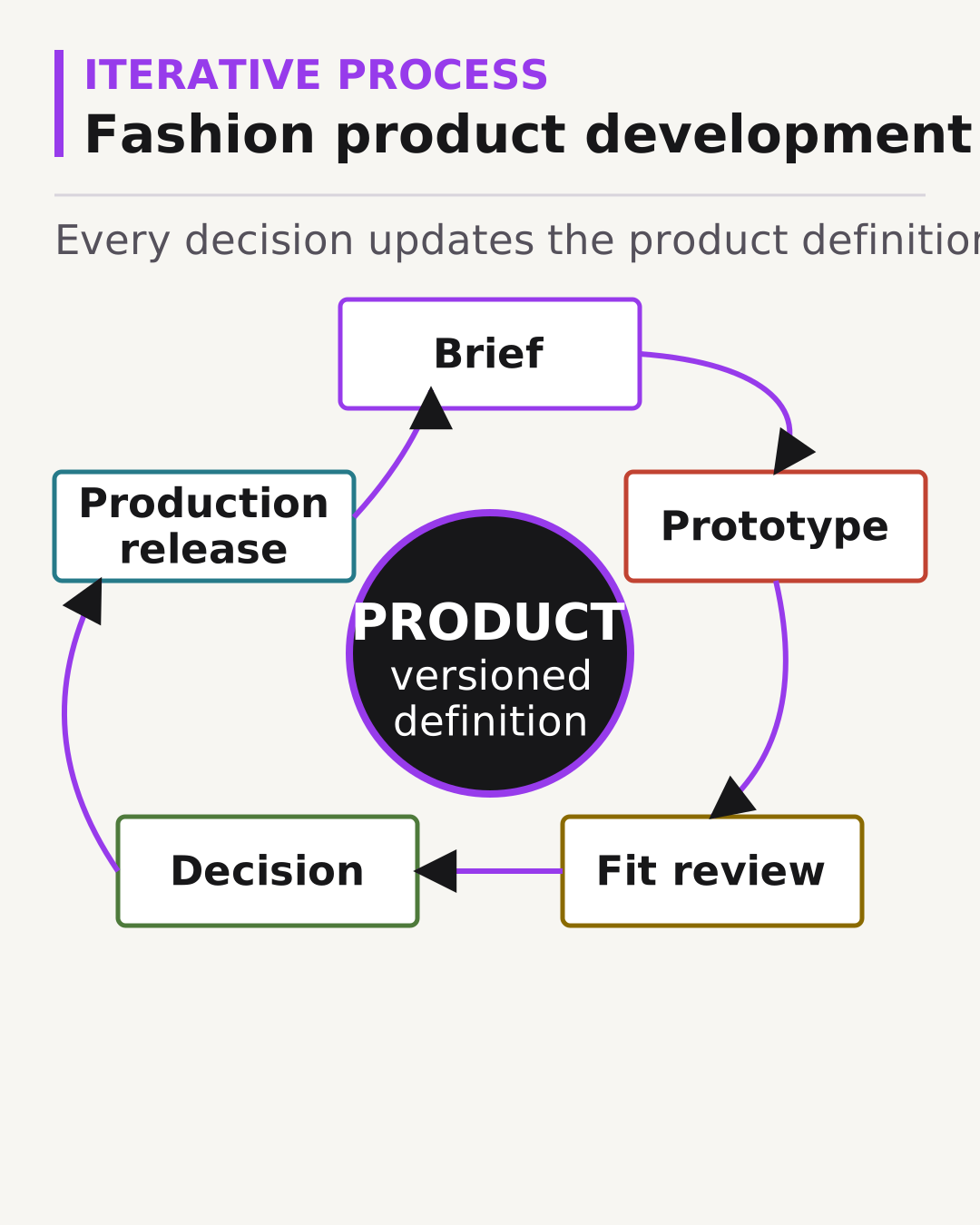
Fashion product development
Fashion product development is the process that turns an opportunity or brief into a product specified and approved for manufacturing. It coordinates concept, assortment, materials, patternmaking, samples, fit, cost, quality, compliance and timing through decision cycles rather than an isolated creative sequence.

Fashion PLM: data, product, and lifecycle
Fashion PLM is the structured management of the data, decisions, and workflows that follow a product and a collection from concept through post-launch. It connects tech packs, materials, costs, samples, approvals, suppliers, and versions so that every function works from a traceable product definition.
Sources
- https://skillsengland.education.gov.uk/media/2305/st0540_fashion-textiles-product-technologist-epa_for_publication_2-october-2018.pdf
- https://www.arts.ac.uk/__data/assets/pdf_file/0031/250798/LCFMAPGTF01-MA-Pattern-and-Garment-Technology-Prog-Spec-2025.pdf
- https://www.iso.org/standard/61686.html
- https://www.iso.org/standard/67334.html
- https://www.gov.br/inmetro/pt-br/acesso-a-informacao/perguntas-frequentes/avaliacao-da-conformidade/produtos-texteis/o-que-a-medida-regulatoria-para-produtos-texteis-estabelece
- https://www.gov.br/inmetro/pt-br/acesso-a-informacao/perguntas-frequentes/avaliacao-da-conformidade/produtos-texteis/se-um-produto-textil-possui-informacoes-incorretas-e-esta-sendo-comercializado-em-territorio-nacional-ele-esta-irregular
- https://www.ftc.gov/legal-library/browse/rules/care-labeling-textile-wearing-apparel-certain-piece-goods-text
- https://catalog.fitnyc.edu/pastcatalogs/2017-18/undergraduate/courses/pm/pm.pdf
Want to apply this to your operation?