AQL inspection in apparel
AQL inspection in apparel applies acceptance sampling to a lot of garments: a sample is examined under a decision rule to accept, reject, or continue sampling. AQL is a reference quality level expressed as a defective percentage; it is not a universal supplier grade or proof that every garment conforms.
On this page
What is AQL inspection in apparel?
AQL is a defective percentage used as a quality reference; in apparel inspection, it belongs to a sampling plan that turns a sample of garments into a lot decision. AQL is not a universal supplier grade: NIST describes it as a baseline requirement for the producer's product and links it to a high probability of accepting a lot with a defect level equal to or below the AQL. Terminology also varies: in 2008, ANSI/ASQ standards related the abbreviation to “acceptance quality level” without changing the underlying meaning.
The result is a probabilistic decision about the lot, not a certification of every unit. An inspection record should therefore separate what was actually examined from what remained outside the sample. That distinction keeps acceptance sampling separate from continuous quality control and from full inspection.
How do lot, sample, and Ac/Re numbers relate?
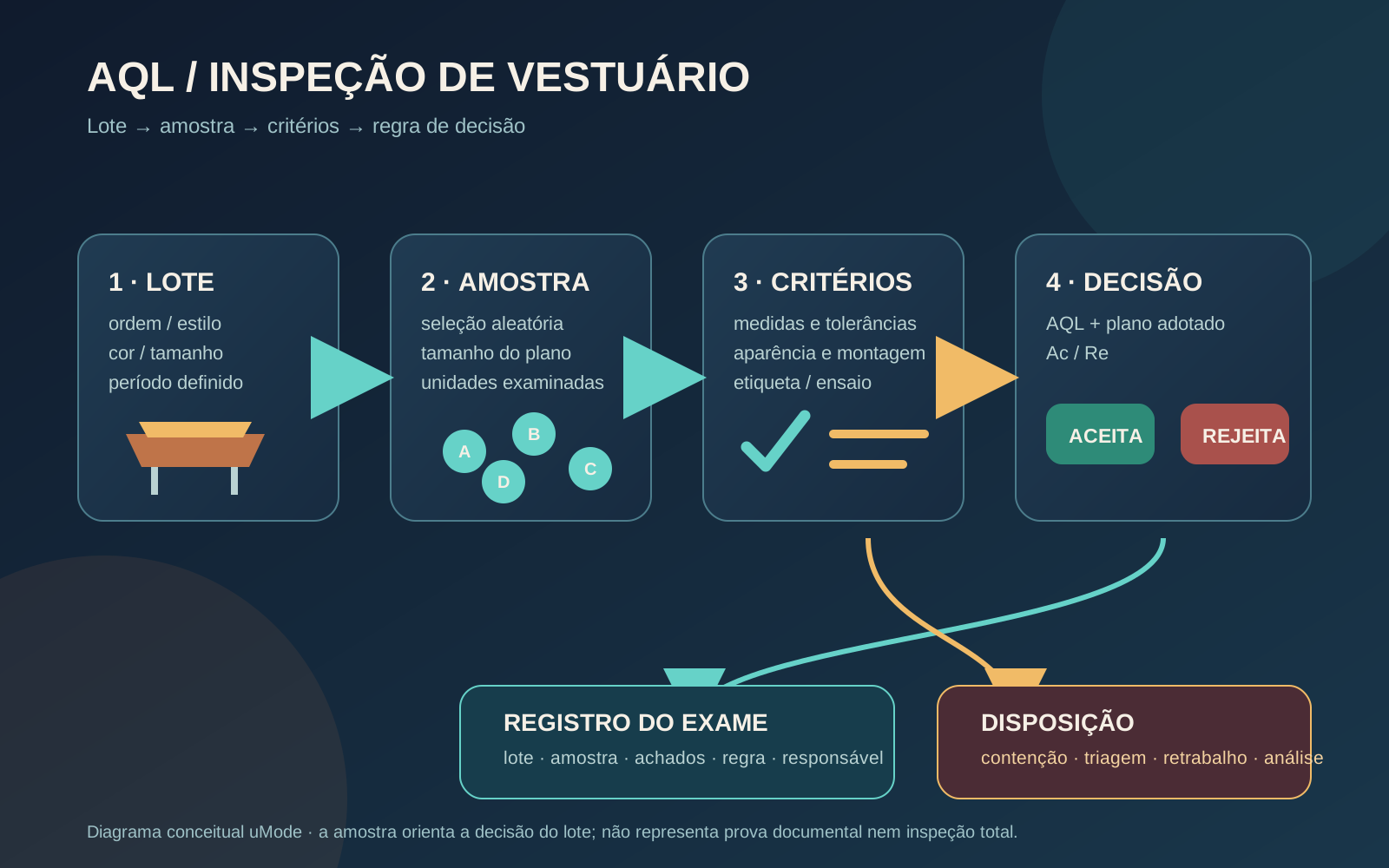
A lot acceptance sampling plan is a scheme with decision rules. In a single plan, items are selected at random from the lot and the observed information determines its disposition; in double or multiple plans, another sample may be taken before the final decision. In apparel, the lot should be delimited in the applicable procedure—for example, by an identifiable combination of order, style, colour, size, and period—so the sample represents the population being decided.
The operating logic can be read as three inputs: lot size, sample size, and the defect limit allowed by the plan. The adopted plan turns that combination into acceptance and rejection numbers, often called Ac/Re. AQL by itself does not state the sample size or authorize a universal table; the team should record the adopted standard or plan, the sample-size code or size, and the Ac/Re values before examining garments. Thus, “AQL 1.5” describes a plan reference, not an inspection verdict without context.
Acceptance sampling sits between no inspection and 100% inspection. The attributes form works as a go/no-go decision, while random selection prevents the team from choosing only certain cartons, stacks, or convenient moments. NIST states that the purpose is to decide whether the lot is likely to be acceptable, not to estimate its total quality.
Which apparel criteria belong in the examination?
Criteria should come from the technical specification and the product requirement: measurements and tolerances, construction, appearance, labels, trims, and packaging can be converted into observable checks. A procedure can classify occurrences by severity and attach approved visual examples; that is control design to reduce disagreement between inspectors, not a universal defect table.
Visual and dimensional inspection does not replace a test when the required property cannot be observed on the garment. AATCC lists TM8 for colorfastness to crocking with a crockmeter, TM61 for accelerated colorfastness to laundering, and TM20A for quantitative fiber analysis. These methods address different questions: colour transfer, laundering behaviour, and fibre composition, respectively. Selection should follow the article requirement and the method defined in the order.
Declared composition also has a regulatory dimension. Regulation (EU) No 1007/2011 addresses textile-fibre names and the labelling and marking of the fibre composition of textile products. When that regulation applies to an order, the record should state the legal scope and verification criterion used rather than treating AQL as a substitute for the labelling obligation.
What does AQL not decide by itself?
Acceptance sampling addresses the disposition of the immediate lot. NIST distinguishes such a plan, which can test short-run effects, from long-run quality control. A rejection can therefore open an investigation into process, material, specification, or supplier; the sampling decision does not identify the cause by itself.
The nonconformity record should retain the lot identity, sampling basis, method, examined units, occurrences, Ac/Re rule, and decision. Final inspection can be a release point, but it needs to remain connected to the other controls. AQL's technical value is to make the relationship between a reference quality level, lot, sample, and decision explicit—and to show what still requires testing, process control, or a legal requirement.
Verified facts
- AQL is a defective percentage that serves as a baseline requirement for the producer's product quality, with a high probability of accepting a lot whose defect level is equal to or below the AQL.
Source: itl.nist.gov ↗ - A lot acceptance sampling plan is a sampling scheme and a set of rules for decisions such as accepting the lot, rejecting it, or taking another sample.
Source: itl.nist.gov ↗ - In a single sampling plan, items are selected at random from a lot and the lot disposition is determined from the resulting information.
Source: itl.nist.gov ↗ - Acceptance sampling sits between no inspection and 100% inspection, and the attributes form is described as a go/no-go decision.
Source: itl.nist.gov ↗ - The main purpose of acceptance sampling is to decide whether the lot is likely to be acceptable, not to estimate the quality of the lot.
Source: itl.nist.gov ↗ - AATCC lists TM8 as a colorfastness to crocking method using a crockmeter.
Source: aatcc.org ↗ - AATCC lists TM61 as an accelerated colorfastness to laundering method.
Source: aatcc.org ↗ - AATCC lists TM20A as a quantitative fiber-analysis method.
Source: aatcc.org ↗ - Regulation (EU) No 1007/2011 addresses textile-fibre names and the labelling and marking of the fibre composition of textile products.
Source: eur-lex.europa.eu ↗ - The abbreviation AQL was related to acceptance quality level in standards issued by at least one national standards organization, ANSI/ASQ, in 2008, while the underlying meaning remained the same.
Source: en.wikipedia.org ↗
Related entries

Apparel quality control
Apparel quality control combines specifications, inspection, and testing to check whether fabrics, trims, and garments meet the expected performance for a product and end use. The process can examine color, drape, hand, durability, conformance, defects, fit, seam integrity, shrinkage, and drying performance. Quality decisions depend on the product and its intended use.

Fashion product technical specification
A technical specification is the controlled information set that translates an approved fashion product into verifiable sampling and manufacturing requirements. It brings together drawings, materials, measurements, construction, tolerances, identification, labelling, comments and revision history; its content varies by category, company, market and stage.
Sources
Want to apply this to your operation?