Team AI adoption
Team AI adoption turns curiosity into operating capability by defining tasks, usage boundaries, guided practice, quality measures, and practical ways to challenge outputs before a tool changes real decisions.
On this page
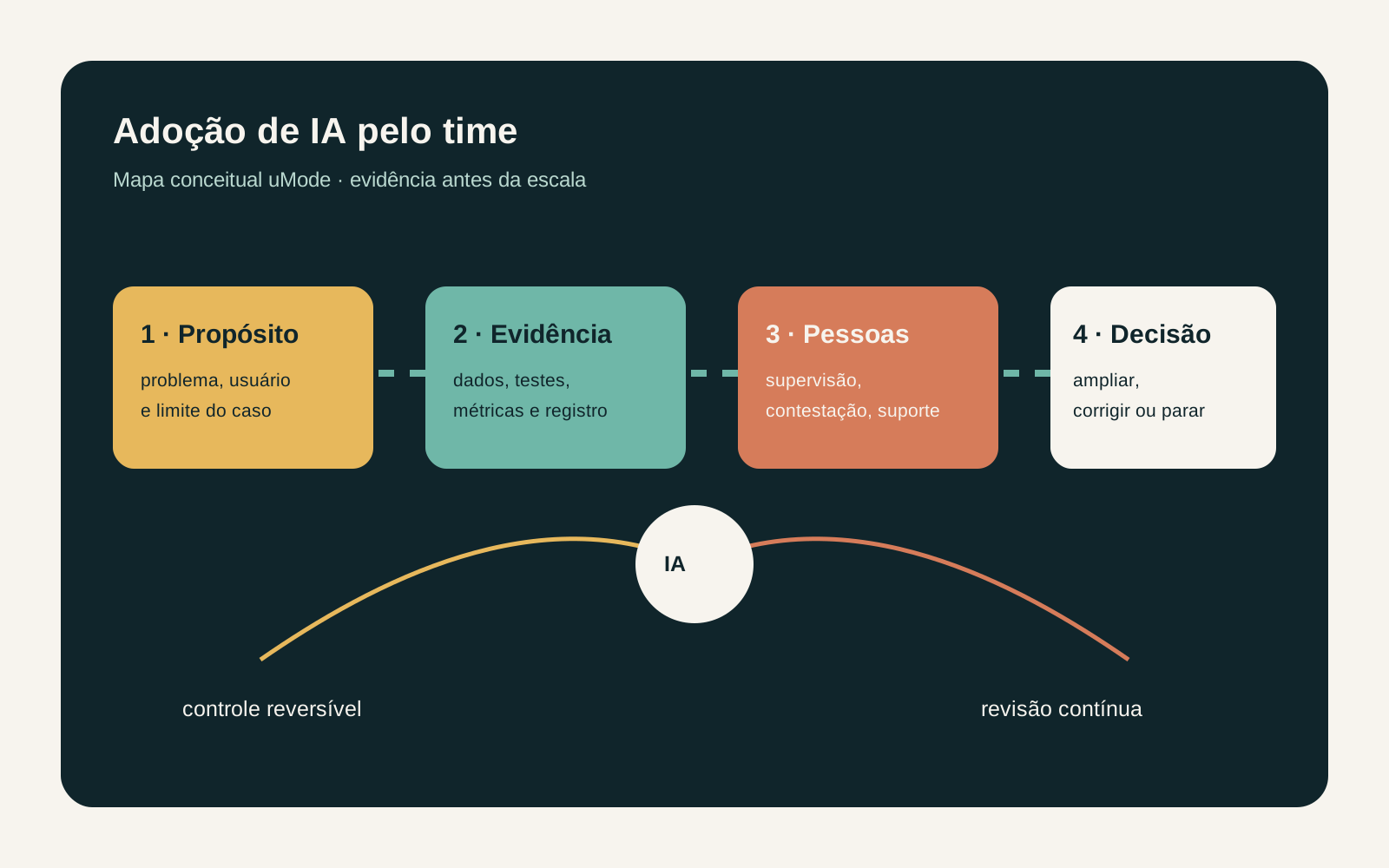
Team AI adoption is not an enthusiasm campaign and it is not the number of accounts created in a tool. It is a shared ability to identify where a system helps, where it adds risk, and what evidence supports a decision. In a product, operations, or content team, begin with a concrete question: which task changes, for whom, with which data, and with what route for correction? That question connects AI literacy, process change, and human oversight without turning technology into an excuse to move responsibility elsewhere.
What is Team AI adoption?
Map tasks before mapping features. Separate writing, retrieval, synthesis, classification, recommendation, and execution. For each task, record the intended outcome, permitted information, tolerable error, and accountable decision-maker. A copy assistant that proposes alternatives may be easy to reverse; a system that ranks applicants, customers, or suppliers needs a different control layer. The team must practise the difference between fluency and correctness: a polished answer still depends on context, sources, and verification.
A useful workshop compares three outputs for one case: a sound answer, a plausible but wrong answer, and an answer that must be rejected. Participants identify uncertainty, check links, remove unnecessary data, and rewrite the request. That makes critical thinking observable. It also gives people language for saying “I do not know”, asking for context, or stopping automation without being labelled anti-innovation.
Which boundaries should exist before first use?
Create a four-column decision table: allowed, allowed with review, must not be entered, and must not be assigned. Names, contracts, health information, credentials, unpublished work, and customer records should not enter a tool without explicit authorisation. State the approved channel, known retention rule, and response when information is exposed. Information security becomes operational when it describes the examples people meet in ordinary work.
Leaders must reserve review time. Responsibility cannot be pushed onto the person who typed the request: the people who set targets, procure the tool, and publish the result also shape the risk. UK public guidance is useful because safety, effectiveness, and security sit in one scope. OECD.AI likewise frames risk and privacy as shared responsibilities. Record who approves a use case, who can stop execution, and how an affected person can challenge an outcome.
How can adoption be measured without rewarding shallow use?
Set a baseline before the tool arrives. Track cycle time, rework, correction rate, perceived quality, errors found in review, data incidents, and the share of cases rejected for risk. For learning, count completed exercises rather than attendance. For quality, distinguish factual error, tone error, omission, leakage, and improper decision. For business impact, compare the task outcome with the prior reference using the same denominator.
Quality measures need to be read beside team accounts. Faster work can hide more rework; heavier use can reflect pressure rather than value. Run short cycles of demonstration, practice, review, and adjustment, retaining failure examples and approved decisions. Reopen the assessment when the model, data, or workflow changes. Google’s emphasis on robust infrastructure and iteration translates into a practical rule: the group needs a channel for recording what differs between testing and live work.
Adoption matures when a new colleague can explain the use, a sceptical operator can question an output, and the team can choose a manual route when risk exceeds benefit. That autonomy is more valuable than a single utilisation index: it builds operating memory, improves the workflow, and keeps human judgement in the right place.
Verified facts
- OECD.AI says AI creates risks and that all actors must be accountable for them.
Source: oecd.ai ↗ - OECD.AI treats data and privacy as primary AI policy issues.
Source: oecd.ai ↗ - OECD.AI connects responsible AI with the development, use, and governance of human-centred systems.
Source: oecd.ai ↗ - The EU Regulation says AI literacy should enable informed decisions about AI systems.
Source: eur-lex.europa.eu ↗ - The European text includes providers, deployers, and affected people within AI literacy.
Source: eur-lex.europa.eu ↗ - The UK guide addresses safe, effective, and secure AI use in public organisations.
Source: gov.uk ↗ - Google recommends robust infrastructure before complex machine-learning algorithms.
Source: developers.google.com ↗ - Google recommends continuous iteration and attention to training-serving skew.
Source: developers.google.com ↗ - NIST’s AI RMF covers AI system design, development, use, and evaluation.
Source: nist.gov ↗ - The NIST Playbook aligns suggestions with Govern, Map, Measure, and Manage.
Source: airc.nist.gov ↗
Sources
- https://oecd.ai/en/ai-principles
- https://eur-lex.europa.eu/eli/reg/2024/1689/oj
- https://www.gov.uk/government/publications/ai-playbook-for-the-uk-government
- https://developers.google.com/machine-learning/guides/rules-of-ml
- https://www.nist.gov/itl/ai-risk-management-framework
- https://airc.nist.gov/airmf-resources/playbook/
Want to apply this to your operation?