Sample approval rate
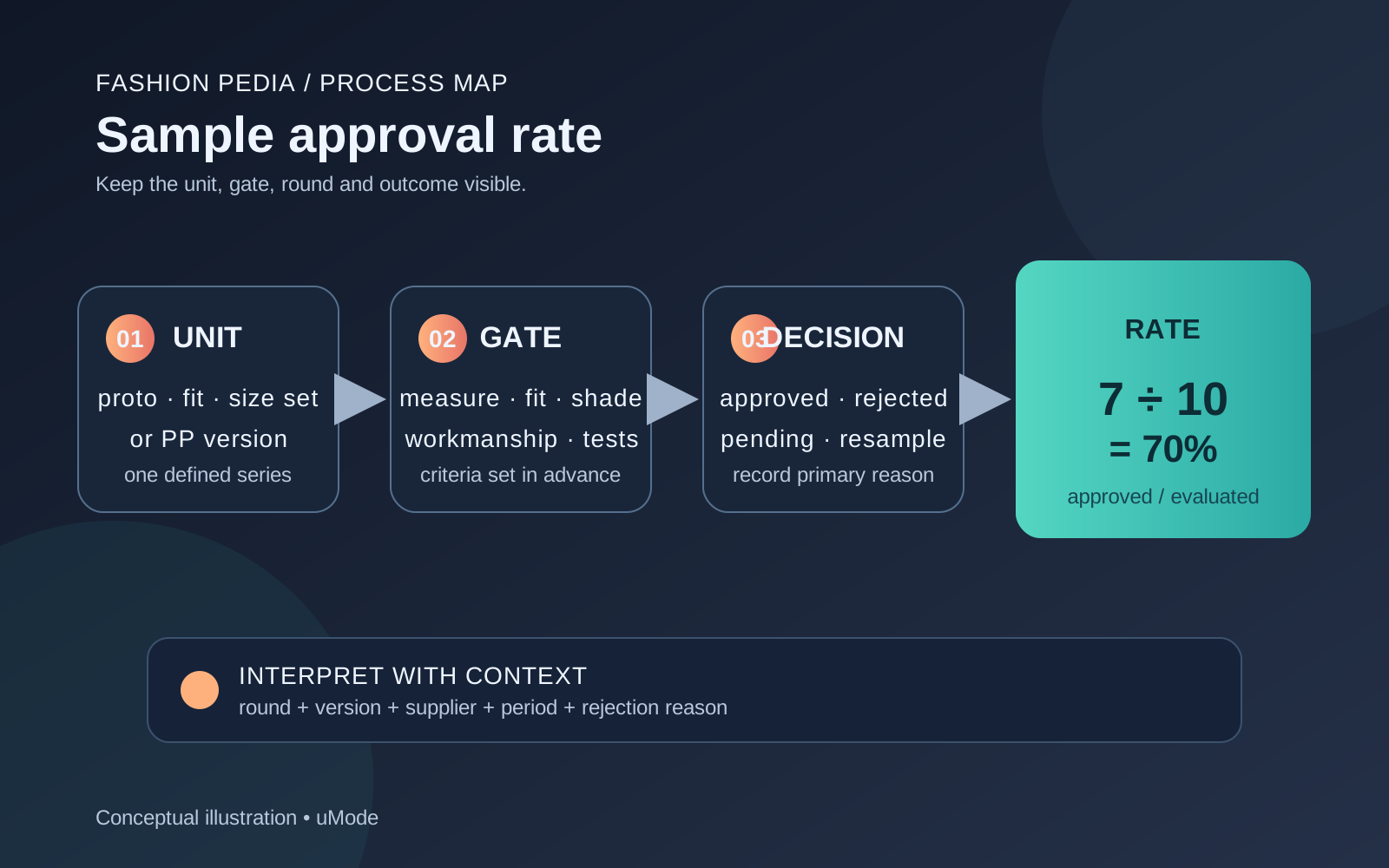
Sample approval rate is an operational indicator calculated as approved samples divided by evaluated samples in the same slice. Comparability requires a fixed unit, round, version, gate, and resample rule; the rate measures the result of the defined gate, not the complete quality of a collection.
On this page
What is Sample approval rate?
The sample approval rate is an operational proportion: approved samples in the numerator and evaluated samples in the denominator, within the same slice. To calculate it, record the unit of analysis, round, product version, supplier, gate, and period; then divide approvals by evaluations and multiply by 100. Example: 7 approvals out of 10 evaluations equals 70%. This calculation is a usage convention for the indicator, not a universal quality threshold.
In product development, “sample” should mean a defined stage rather than any piece placed on a review table. Keep prototype, fit sample, size set, and pre-production sample in separate series. A pending sample is neither approved nor rejected: keep it outside the denominator until a decision exists, provided the rule is applied consistently across rounds.
Which technical gates belong in the decision?
The gate must state what is being approved. For measurements and shrinkage, AATCC TM150 provides a technical scope for garment length and width after home laundering; operationally, compare the garment with the measurement chart and record the deviation before deciding. For color, TM8 measures transfer by rubbing under controlled conditions; a crocking failure can therefore reject a sample even when the pattern is correct. For construction, TM88B addresses seam smoothness after laundering, which is useful when seam appearance is part of the gate.
Color, measurement, fit, workmanship, trims, and documentation should not be collapsed into one “approved” label without a reason. Record the primary rejection reason and classify additional reasons as secondary. The total rate answers “how many passed?”, while the reason distribution answers “what is failing?”. Quality control and laboratory testing can feed the decision, but they are not synonyms for the rate.
How should rounds, resamples, and interpretation be handled?
Choose before collection whether to count every submission or each style/version once. Counting submissions shows the real workload of the flow; counting versions shows how many products reached an approved state. Do not mix those denominators in one series. When a rejection returns as a resample, keep its link to the original version and mark the round; counting the resample as a new approval can inflate the rate if the question is “how many styles passed first time?”.
Acceptance-by-attributes logic helps separate a decision from an estimate: NIST describes plans that count defectives to accept, reject, or request another sample, and notes that sampling decides the likely disposition of a lot rather than estimating its quality. For an internal gate, declare the acceptance number and stopping rule; do not import an AQL or acceptance curve without defining the lot, unit, and risk. That statistical logic is sampling context, not permission to turn a prototype approval rate into a mass-production inspection.
The indicator helps locate bottlenecks between PLM, patternmaking, supplier, and quality: a measurement decline points to specification or grading review; a color decline points to material or finishing control; a seam decline points to construction and preparation. These are investigation routes, not automatic diagnoses. Read the rate with reasons, cycle time, and sample stage, never as isolated proof of commercial quality.
Verified facts
- In acceptance sampling, a sample is used to decide whether a lot should be accepted or rejected, not to estimate the quality of the lot.
Source: itl.nist.gov ↗ - An acceptance sampling plan is a scheme with decision rules; by counting defective units, it can accept, reject, or request another sample.
Source: itl.nist.gov ↗ - AQL is the percent defective that serves as the baseline quality requirement for the producer's product in a sampling plan.
Source: itl.nist.gov ↗ - AATCC TM150 determines dimensional changes in length and width for garments subjected to home laundering procedures.
Source: members.aatcc.org ↗ - AATCC TM8 determines the amount of color transferred from the surface of a colored textile material to another surface by rubbing under controlled conditions.
Source: members.aatcc.org ↗ - AATCC TM88B determines seam smoothness appearance in fabrics after home laundering procedures.
Source: members.aatcc.org ↗ - AATCC TM61 evaluates colorfastness to laundering and surface changes in textiles subjected to accelerated laundering.
Source: members.aatcc.org ↗ - NIST places acceptance sampling between no inspection and full inspection.
Source: itl.nist.gov ↗
Related entries

Sources
Want to apply this to your operation?