Arezzo&Co
Arezzo&Co was the fashion, footwear and accessories company that joined Grupo Soma in 2024 to create Azzas 2154. Its corporate path includes the 2007 merger between Arezzo and Schutz, the 2011 stock-market listing and a portfolio later organized into four business units.
On this page
What is Arezzo&Co?
Arezzo&Co was a Brazilian fashion, footwear and accessories company whose corporate identity entered a new configuration in 2024. The investor-relations history records that the merger of Arezzo and Schutz created Arezzo&Co in 2007; in 2011, the company went public on B3. In 2024, Arezzo&Co and Grupo Soma joined to create Azzas 2154. This sequence prevents Arezzo&Co and Azzas 2154 from being treated as interchangeable names across every period.
The timeline connects Arezzo and Schutz to a corporate structure that later gathered additional brands. It also separates a footwear label, the company managing a portfolio and the successor company created by the business combination. For historical reading, the year must stay attached to the event: the company’s origin is a 2007 record, the listing is a 2011 record and the combination that created Azzas 2154 is a 2024 record.
How was the portfolio and business model organized?
The business model presented by Azzas 2154 operates through four units: Shoes & Bags, Fashion & Lifestyle Women, Basic and Fashion & Lifestyle Men. This division is a useful key for reading a group that cannot be reduced to one product category. A business unit is a corporate layer; it does not replace each brand’s identity, audience or calendar.
On the brands page, Arezzo is described through concept, high quality and contemporary design. Anacapri is described as casual and associated with flat footwear. These descriptions are institutional brand positioning, not an independent assessment of quality. The links to footwear, fashion accessories and fashion retail should therefore preserve each label’s scope rather than assign one style to the whole company.
What channel scale did the company report?
The history page reports more than 2,000 stores, including 1,500 franchises, a presence in 21,500 multi-brand stores, more than 11 million customers moving through its channels and revenue above 12 billion Brazilian reais. These figures belong to the company’s institutional communication and should be read as a snapshot of the scope stated on that page, not as timeless indicators or proof of performance for every brand.
For fashion professionals, the value of these figures is that they show the range of decisions a group of this scale must coordinate: assortment, calendar, channels, partners and identity. Collection management and collection planning are editorial links for investigating those decisions; they are not evidence that the company uses a specific internal process. Likewise, product development names a value-chain stage, not a conclusion about operational efficiency.
How should Arezzo&Co be distinguished from related names?
The first distinction is temporal: Arezzo&Co names a corporate phase before the 2024 combination, while Azzas 2154 is the name used for the later structure. The second is one of level: Arezzo and Anacapri are brands; Arezzo&Co was a company; Azzas 2154 is the company resulting from the combination recorded in the history. The third concerns sources: retail figures, brand positioning and market classifications have different scopes.
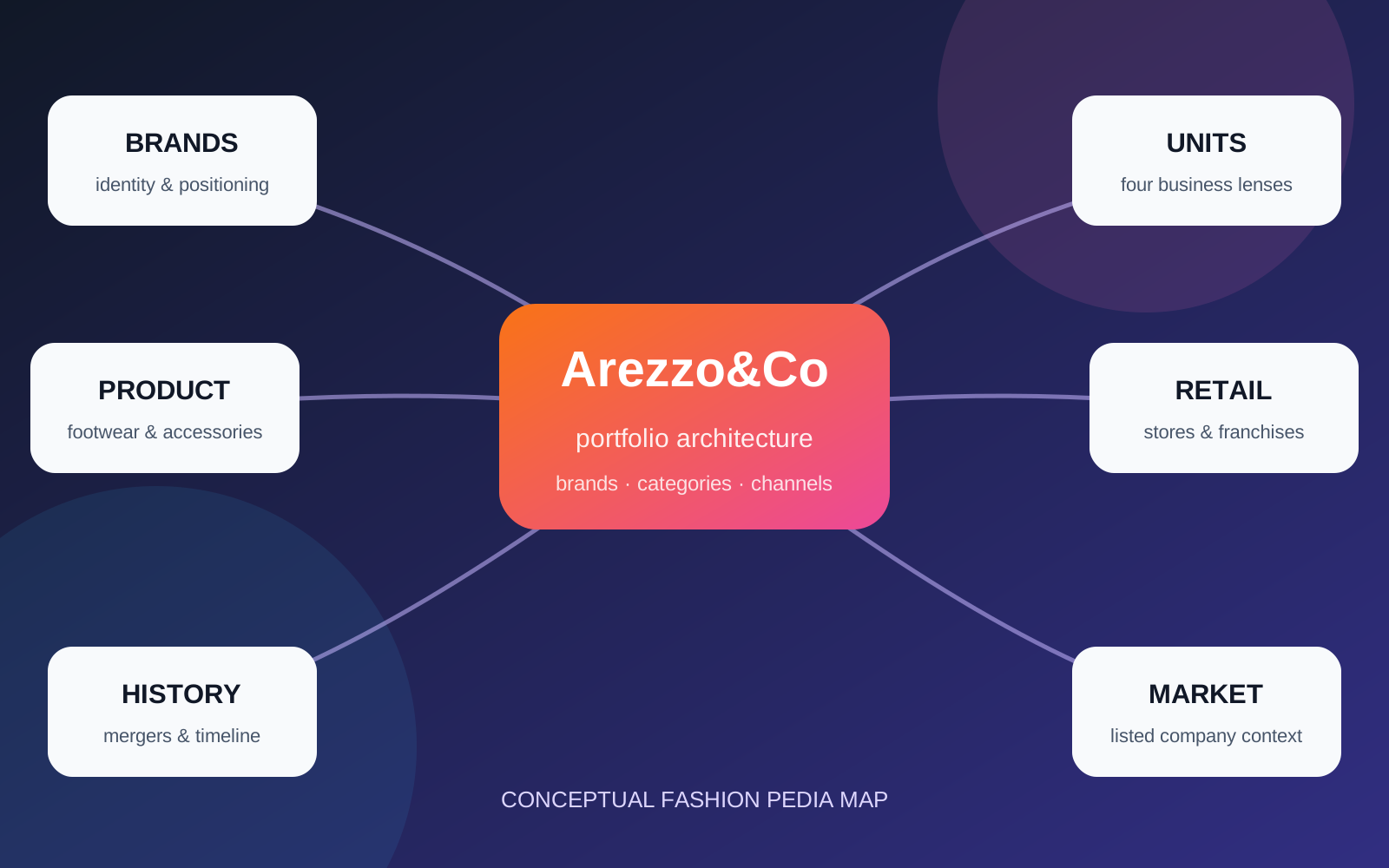
Fundamentus classifies AZZA3 in Commerce and in the Textiles, Clothing and Footwear subsector. Wikipedia records Azzas 2154 S.A. as a publicly traded company with the B3:AZZA3 quotation. Those records help anchor the entity in the Brazilian market, but they do not replace corporate documents when interpreting operations, brands or results. The entry is most useful when it keeps these layers separate and uses the graph to connect them without merging them.
Verified facts
- Arezzo&Co and Grupo Soma joined in 2024 to create Azzas 2154.
Source: ri.azzas2154.com.br ↗ - Arezzo&Co was created in 2007 through the merger of Arezzo and Schutz.
Source: ri.azzas2154.com.br ↗ - Arezzo&Co went public on B3 in 2011.
Source: ri.azzas2154.com.br ↗ - Azzas 2154 presents its business model through four units: Shoes & Bags, Fashion & Lifestyle Women, Basic and Fashion & Lifestyle Men.
Source: ri.azzas2154.com.br ↗ - The company history page reports more than 2,000 stores, 1,500 franchises and a presence in 21,500 multi-brand stores.
Source: ri.azzas2154.com.br ↗ - The company history page reports that more than 11 million customers move through its channels.
Source: ri.azzas2154.com.br ↗ - The company history page reports revenue above 12 billion Brazilian reais.
Source: ri.azzas2154.com.br ↗ - The brands page describes Arezzo through concept, high quality and contemporary design.
Source: ri.azzas2154.com.br ↗ - The brands page describes Anacapri as a casual brand associated with flat footwear.
Source: ri.azzas2154.com.br ↗ - Fundamentus classifies AZZA3 in Commerce and in the Textiles, Clothing and Footwear subsector.
Source: fundamentus.com.br ↗ - Wikipedia records Azzas 2154 S.A. as a publicly traded company with the B3:AZZA3 quotation.
Source: pt.wikipedia.org ↗
Sources
Want to apply this to your operation?